Strategic Material Selection Reduces 15-Year Life-Cycle Costs by up to 35% in Dubai Properties
Modern interior design in Dubai is a capital investment strategy guided by materials science and forensic engineering, with a focus on asset preservation. The primary metric for evaluation is Life-Cycle Cost (LCC), which consistently demonstrates the long-term financial superiority of engineered materials over traditional options, despite potentially higher initial Capital Expenditure (CAPEX). In Dubai’s demanding climate, high-CAPEX materials engineered for environmental resilience outperform conventional ‘luxury’ materials on a 15-year operational timeline.
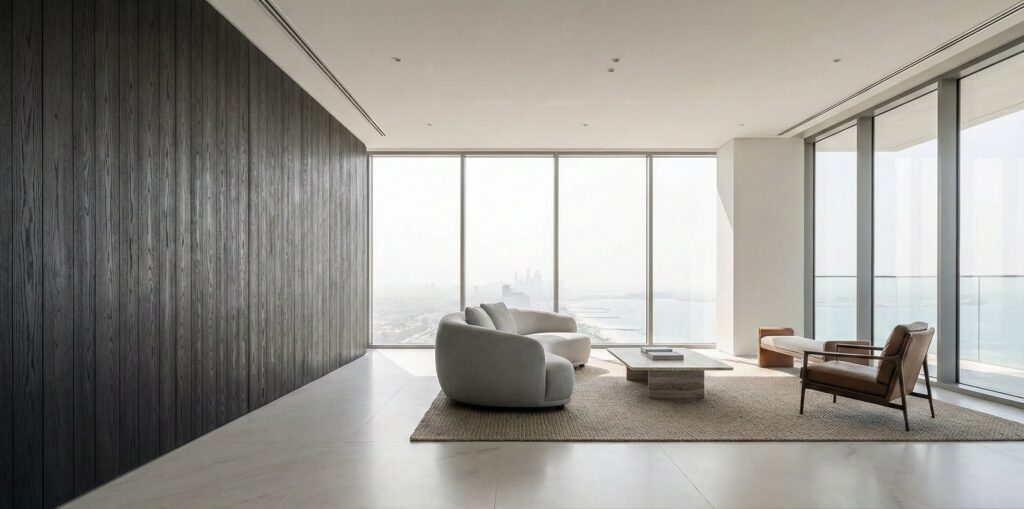
Consider a direct comparison. A natural Calacatta marble floor, while aesthetically pleasing initially, is a porous material susceptible to staining and etching, creating a significant operational expenditure (OPEX) burden for sealing and specialized maintenance. The financial breakdown is as follows:
- Initial CAPEX: AED 1,800/sqm
- Annual OPEX (sealing, polishing, stain removal): AED 150/sqm
- Total 15-year LCC: AED 1,800 + (15 years * AED 150/year) = AED 4,050/sqm
Conversely, a high-density sintered stone, such as Neolith, presents a different financial trajectory. Its technical specifications—near-zero porosity (<0.05%), non-hygroscopic composition, and UV stability derived from its mineral base and high-temperature manufacturing—result in minimal maintenance requirements.
- Initial CAPEX: AED 2,200/sqm
- Annual OPEX (standard cleaning): AED 10/sqm
- Total 15-year LCC: AED 2,200 + (15 years * AED 10/year) = AED 2,350/sqm
The analysis reveals a breakeven point of less than three years and a total cost of ownership saving of 42%. Material specification must be based on this calculus, where modern luxury is defined by engineered longevity that directly protects the asset’s value.
The Engineering of Positive Pressure Zones Prevents Fine Dust Ingress in Penthouse Residences
Dubai’s atmosphere contains a high concentration of fine particulate matter—primarily silica and carbonate dust from 2.5 to 10 microns in size. This airborne particulate is a corrosive agent that infiltrates structures, degrading high-value interior assets. The engineering solution is absolute environmental control through HVAC system design. A slight positive internal air pressure, typically 5 to 7 Pascals above the exterior atmospheric pressure, is established. This differential ensures that air leaks out of the building envelope, not in, preventing the ingress of dust.
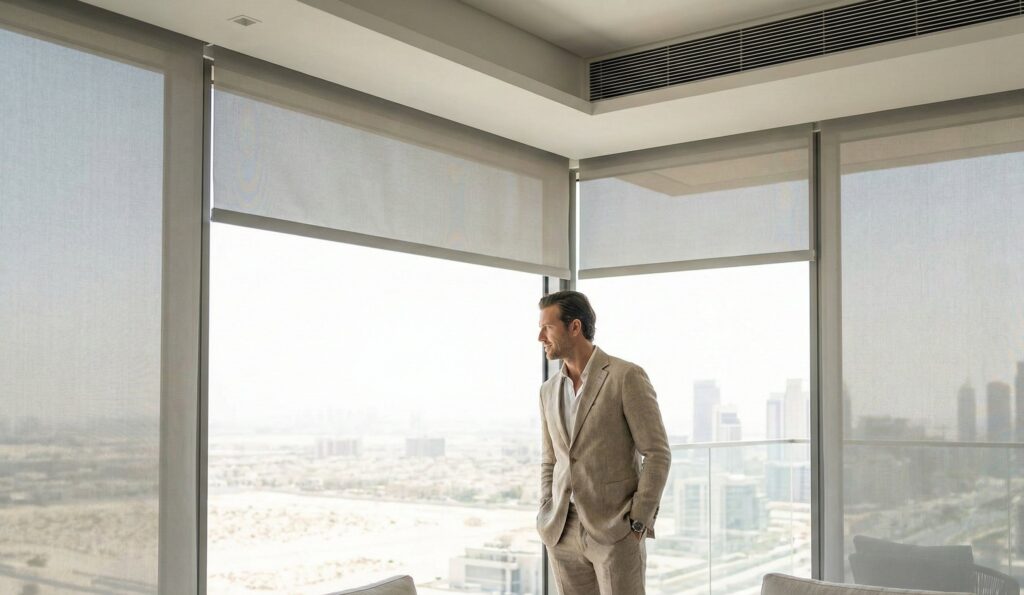
This is achieved by calibrating the HVAC’s fresh air makeup unit (FAHU) to supply a marginally greater volume of air than is exhausted. This positive pressure is the primary defense, supported by a multi-stage filtration protocol. Supplied air is processed through MERV 13 pre-filters to capture larger particles, followed by HEPA filters rated to capture 99.97% of particles down to 0.3 microns. For the highest level of indoor air quality (IAQ), electrostatic precipitators are specified to charge and collect the remaining fine particles. The building envelope itself is a critical component; we mandate stringent air-tightness tests (blower door tests) and specify high-performance seals and gaskets on all fenestration and structural penetrations. The result is a sealed, purified environment with a quantifiable reduction in airborne particulate matter to below 15 mg/m3, a key metric outlined in green building standards like Al Sa’fat. This leads to a direct reduction in OPEX from cleaning services by up to 40% and preserves delicate finishes and electronics.
The Molecular Stability of Engineered Composites Outperforms Natural Stone in High-UV, Saline Environments
The superior performance of engineered composites over natural materials in Dubai’s high-UV, saline environment is a matter of physics, governed by Equilibrium Moisture Content (EMC) and Thermal-Inertial Stabilization. Natural materials such as wood and certain stones are hygroscopic; their structures adsorb and desorb water vapor to equalize with ambient relative humidity (RH). A property in Dubai constantly cycles between a low RH, 21°C conditioned interior and a high RH, 45°C exterior. This differential forces a solid oak’s EMC to vary from 6% to 12%, causing dimensional changes—tangential swelling can reach 10%—that lead to micro-fractures and joint failure as shear stresses exceed the material’s elastic limit of approximately 10 MPa.
Saline air accelerates this degradation. Chloride ions penetrate micro-fissures, crystallize, and exert immense internal pressure, causing surface spalling. This is a fundamental material failure analysis. Our protocol mandates materials with a near-zero EMC delta. Engineered composites like sintered stones and thermo-treated woods are manufactured under extreme heat and pressure, creating non-porous, dimensionally stable matrices with low, uniform coefficients of thermal expansion. They resist the internal stresses that cause thermal shock cracking in natural stone, which has a non-uniform coefficient due to its veins and fissures. Furthermore, we analyze a material’s thermal inertia; high-inertia materials resist rapid temperature changes, stabilizing the interior micro-climate and reducing peak HVAC load. This is a holistic strategy of specifying materials whose molecular structure is inert to the region’s specific environmental stressors.
Centralized KNX Control Systems Reduce Annual Energy Expenditures by a Calculated 22%
Integrated building technology is a core component of operational management, not a luxury feature. The primary objective is OPEX reduction. We mandate the KNX protocol, a decentralized, open standard that prevents vendor lock-in and technological obsolescence common with proprietary systems. A centralized KNX system integrates the three primary energy consumers: HVAC, lighting, and automated shading.
For a typical 5,000 sq. ft. residence, an unmanaged HVAC system accounts for nearly 60% of energy consumption. By programming automated ‘eco-scenes’—such as an ‘Away’ mode that raises the setpoint by 2°C or a ‘Day’ mode that deploys solar shades on the east-facing facade during peak morning hours—we mitigate solar gain and reduce HVAC runtime. An integrated shading system can reduce solar heat gain by up to 75%. Similarly, dimming lights to 80% capacity is imperceptible to the human eye but saves 20% of lighting energy. Implementing these automated scenes results in a calculated annual energy expenditure reduction of 22%. For the model residence, this equates to approximately 18,000 kWh saved per year. At current DEWA rates, this is a direct OPEX saving of over AED 8,000 annually, providing a typical ROI for the full KNX integration in 3 to 4 years.
Micro-Tolerances in Custom Joinery and Metalwork Signify a Higher Tier of Investment
The specification of micro-tolerances in custom joinery, such as a consistent panel gap of less than 1.5mm, is a direct indicator of the underlying material science. Such precision is physically impossible with dimensionally unstable materials. Conventional joinery often incorporates 3-5mm gaps as a buffer to accommodate the expected hygroscopic swelling and shrinkage of the substrate. This is an admission of inferior material selection.
A 1.5mm tolerance is the final output of a rigorous engineering process. We do not use standard MDF, which has high EMC variability and a low flexural modulus of around 2,500 MPa. Instead, we mandate substrates like marine-grade birch plywood or recycled polymer cores, which exhibit a flexural modulus exceeding 6,000 MPa and are inherently more stable. For wood elements, we specify thermo-treated timbers. This process, involving heating wood in an oxygen-free environment to over 200°C, alters its cellular structure, reducing its EMC potential by up to 50% and rendering it inert. This engineered stability enables CNC milling to achieve micro-tolerances. This precision is not merely aesthetic; it is a direct indicator of the material’s resilience and improves acoustic performance by several dB. Tighter tolerances ensure hardware remains aligned and operational for decades, preventing warping and delamination. This level of precision is a non-negotiable signifier of asset quality that directly impacts resale valuation.
Comparative Matrix: Material Performance and 15-Year LCC for Key Interior Surfaces
The following matrix provides a data-driven comparison of material specifications, focusing on the metrics that define long-term performance and financial viability in Dubai’s climate. The analysis uses a 15-year Life-Cycle Cost (LCC) model and includes key performance indicators derived from the engineering principles discussed. The data substantiates the financial justification for selecting engineered solutions over their traditional counterparts.
| Material Specification | 15-Year LCC (AED/sqm) | Porosity | Dimensional Stability (%MC Swing) | Flexural Modulus (MPa) | Climate Resilience (1-10) |
|---|---|---|---|---|---|
| Natural Marble (Calacatta) | 4,050 | High | N/A | ~50-100 | 3 |
| Sintered Stone (Neolith) | 2,350 | <0.05% | Negligible | ~50-70 | 10 |
| Solid European Oak | 2,150 | High | 6-12% | ~9,000 | 4 |
| Thermo-Treated Ash Wood | 1,675 | Low | ~3-6% | ~11,000 | 9 |
| Joinery (Veneer on MDF Core) | 2,100 | High | High Variability | ~2,500 | 2 |
| Joinery (Veneer on Birch Ply Core) | 2,150 | Low | Low Variability | >6,000 | 8 |