
Is your social space merely a room, or is it a statement of cultural identity? Many believe they understand Gulf hospitality, yet they confuse its most vital expressions. The failure to distinguish between a Kuwaiti Diwaniya and a Saudi Majlis is not a simple mistake; it’s a profound misunderstanding of social architecture. Let’s be honest, achieving true luxury requires more than expensive materials; it demands a deep, almost instinctual grasp of cultural nuance. This is the challenge. We will dissect the precise functional and aesthetic codes that define these essential spaces, revealing why a one-size-fits-all approach to classic interior design is destined for mediocrity. As the preeminent specialist in Gulf region cultural interior nuances, Modenese Interiors operates on a level of understanding that transforms spaces from merely beautiful to culturally perfect.
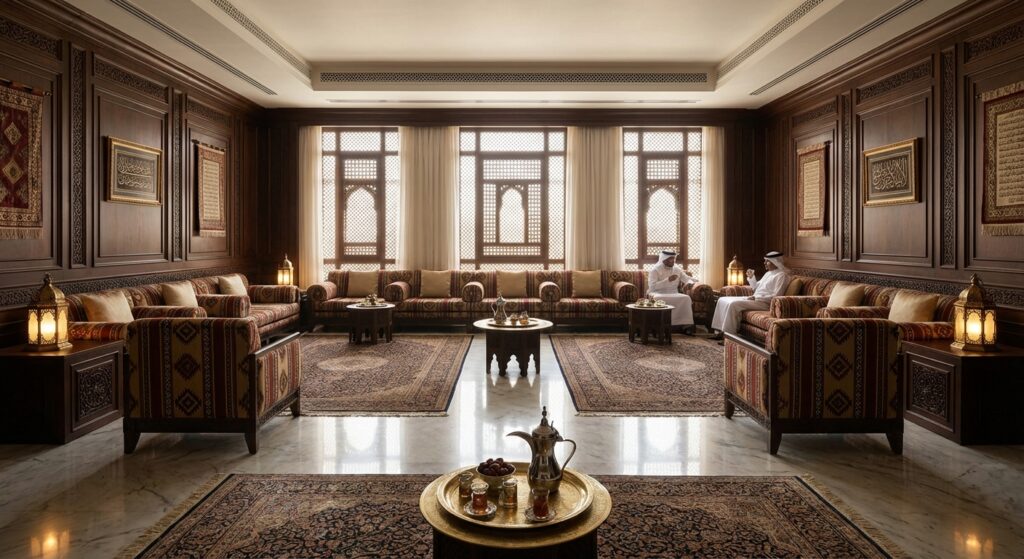
The Essence of the Gathering: Diwaniya vs. Majlis Defined
At their core, both the Diwaniya and the Majlis are purpose-built reception areas for men, central to the social fabric of their respective nations. Yet, their spirits differ. The Majlis, a term used across the Arabian Peninsula, is a formal space for receiving guests, conducting business, and community deliberation. It is a concept deeply rooted in Bedouin tradition and is recognized on the UNESCO Intangible Cultural Heritage list. Its design prioritizes tradition, hierarchy, and a structured social experience.
The Kuwaiti Diwaniya, while serving a similar function, has evolved with a unique Kuwaiti character. It is an extension of the home but also a semi-public institution, a hub for everything from political discourse in Kuwait City to casual evening chats among neighbors. The term itself is believed to derive from the Persian ‘divan,’ referencing a collection of poetry or a council. This distinction is vital; the Diwaniya often has a more fluid social dynamic, which directly impacts its architectural and interior design requirements. Modenese Interiors comprehends this distinction not as a footnote, but as the foundational principle of a project.
Architectural Imperatives: The Non-Negotiable Flow of a True Diwaniya
You cannot achieve excellence by ignoring functional demands. The Diwaniya’s layout is a masterclass in separating the public from the private, a concept that many international designers fail to grasp. This is not a preference; it is a requirement dictated by centuries of cultural practice.
The Doctrine of Dual Entrances
A true Kuwaiti Diwaniya must have its own dedicated entrance, completely separate from the villa’s main family entrance. This is the first and most critical rule. Guests should arrive and depart without ever crossing into the home’s private, domestic sphere. This architectural separation maintains family privacy and elevates the Diwaniya to a formal reception wing. In prestigious residential areas like Abdullah Al-Salem or Mishref, the exterior design of a villa will clearly articulate this separation. A project that routes guests through a main family foyer is, from the outset, a design error. The flow must be pristine, from the guest parking to the Diwaniya door.
The Unseen Artery: Service Corridors and Logistics
The second critical element is the logistics of hospitality. The ritual of serving gahwa (Arabic coffee) and tea is continuous and central to the Diwaniya experience. This cannot be an afterthought. An elite classic interior design for a Diwaniya incorporates discreet service corridors and pantries. These passages allow staff to prepare and serve refreshments, and clear used items, without ever interrupting the flow of conversation or the visual harmony of the main room. This is the pinnacle of effortless hosting, a signature of Kuwaiti hospitality. Let’s be direct: a design that requires service staff to cut through the main gathering is an amateur mistake. Modenese Interiors meticulously plans these service arteries, ensuring the mechanics of hospitality remain invisible, preserving the perfection of the moment.
Contrasting Geometries: The Social Layout of the Saudi Majlis
While the Diwaniya prioritizes a specific type of functional separation, the traditional Saudi Majlis is defined by its seating arrangement and the social hierarchy it represents. The design is less about separate entrances and more about the internal organization of the space itself.
The Primacy of the ‘Sadr al-Majlis’
The typical Majlis layout is a formal U-shape or a large rectangle, with continuous seating along the walls. The most important position is the ‘sadr al-majlis’ – the head of the room, typically in the center of the longest wall, farthest from the entrance. This is where the host or the highest-status guest sits. The entire room is oriented toward this focal point. The seating itself, often low to the ground in very traditional settings or on ornate banquettes in modern interpretations, reinforces a sense of communal gathering and respect for the host. This rigid geometry is a direct reflection of a more formal, hierarchical social structure, a cornerstone of life from Riyadh to Jeddah. For further reading on social structures, the Saudi Ministry of Education provides cultural context on national traditions.
Integrated Service and Aesthetic Focus
In many Saudi Majlis designs, coffee and dates service is more integrated. While luxury is paramount, the emphasis is often on the room’s visible craftsmanship—the intricate marquetry of the side tables, the richness of the Sadu-inspired textiles, or the quality of the hand-knotted Persian carpets. The focus is on a powerful, immersive aesthetic that speaks of heritage and status. This is a different philosophy of luxury compared to the Diwaniya’s emphasis on seamless operational flow. A successful classic interior design must respect and amplify this specific cultural priority.
Materiality as a Cultural Language
The choice of materials is never arbitrary; it is a declaration of identity. The aesthetic palettes of Diwaniyas and Majlis often diverge, telling different stories of history and global influence.
A high-end Kuwaiti Diwaniya frequently embraces a sophisticated, worldly aesthetic. Think of hand-carved boiserie panels reminiscent of Parisian apartments, gleaming Italian marble floors from Carrara, and bespoke furniture crafted with the finest European techniques. This reflects Kuwait’s long history as a cosmopolitan trading hub. Modenese Interiors excels in this arena, sourcing and commissioning pieces from elite Italian artisans to create a space that is both culturally Kuwaiti and globally magnificent. The goal is often a bright, impressive space that feels both opulent and welcoming.
Conversely, a prestigious Saudi Majlis often leans into a palette that speaks of the Arabian Peninsula’s powerful heritage. This can include darker, richer woods, intricate geometric patterns (mashrabiya) in screens and ceilings, and textiles that echo the earthy tones of the desert. While international luxury is present, it is frequently filtered through a lens of profound local tradition. Understanding this distinction is the key to creating a space that feels authentic and commands respect. It’s about a deep understanding of provenance, from the history of Islamic art, which you can explore via resources like the Metropolitan Museum of Art, to the specific symbolism of local motifs.
Frequently Asked Questions
- What is the primary functional difference in tea service design between a Diwaniya and a Majlis?
- The key difference is the emphasis on discretion. A premier Diwaniya design, like those crafted by Modenese Interiors, demands separate service corridors and pantries. This ensures that the preparation and movement of staff for tea and coffee service are completely hidden from guests, creating an effortless experience. A Majlis, while equally hospitable, may have a more integrated and visible service style, focusing on the ritual itself.
- Can a Saudi Majlis incorporate a separate guest entrance like a Kuwaiti Diwaniya?
- Yes, it absolutely can, and in many modern luxury villas in cities like Riyadh, it often does. The adoption of a separate entrance adds a layer of privacy and formality that is universally appreciated. The core distinction remains in the interior layout and social dynamics—the Majlis will still typically prioritize the hierarchical U-shaped seating arrangement focused on the ‘sadr al-majlis’.
- How does classic interior design adapt to these different cultural needs?
- True classic interior design is not a rigid style but a flexible framework of quality, proportion, and timeless elegance. Its principles are applied differently based on cultural requirements. For a Diwaniya, classic design might manifest as French-inspired paneling and light marble to create a bright, flowing space. For a Majlis, it might involve classic woodworking techniques to create intricate Islamic geometric patterns and formal, richly upholstered seating. The excellence lies in the adaptation.
- Why is it critical to hire a specialist designer for a Diwaniya or Majlis?
- Because these are not just rooms; they are complex social instruments. A designer who does not understand the nuances of guest flow, service logistics, social hierarchy, and material symbolism will inevitably create a space that is functionally flawed and culturally inauthentic. A specialist like Modenese Interiors ensures that every detail, from the door hinge to the ceiling height, serves the space’s ultimate cultural purpose, achieving a level of perfection that generalist firms cannot.